Residential properties throughout central Ohio face aggressive pressure from floodwater and container-breeding species from May through October. Successful population collapse requires targeting the physiological…
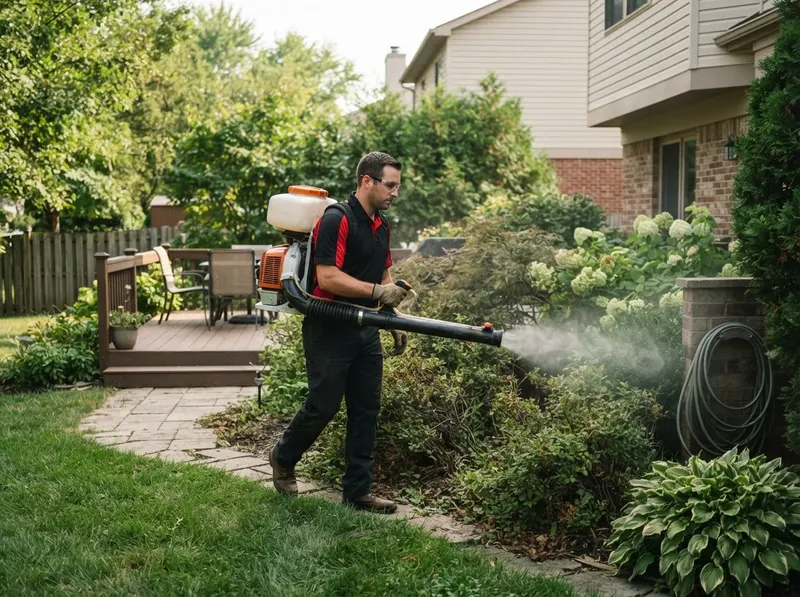
Residential properties throughout central Ohio face aggressive pressure from floodwater and container-breeding species from May through October. Successful population collapse requires targeting the physiological habitats of vector species like Culex pipiens, which transmit pathogens tracked by the Ohio Department of Health. Surface fogging alone fails when subsurface breeding reservoirs remain active. EmberVale Exterminators executes an integrated suppression protocol that combines botanical microencapsulated adulticides on perimeter foliage with micro-droplet delivery to the undersides of dense ornamental leaves. Technicians treat non-draining areas using selective Bacillus thuringiensis israelensis (Bti) formulations regulated by the United States Environmental Protection Agency, neutralizing larval instars before emergence without disturbing non-target aquatic organisms.
Dense canopy shade and low-lying river corridors amplify moisture retention across Columbus communities. In historic neighborhoods like German Village and Victorian Village, brick courtyards and zero-lot-line perimeter fences trap stagnant air pockets that shield adult resting sites. Properties bordering the Olentangy River corridor in Clintonville and Worthington experience constant resurgence from riparian woods, requiring structured barrier zones anchored against perimeter tree lines. Similarly, older stormwater systems and mature oak shade across Bexley, Upper Arlington, and Grandview Heights demand forensic inspection of catch basins, downspout extensions, and neglected plant saucers. Outlying zones across Franklinton, Olde Towne East, and properties near the Short North Arts District require localized windbreak treatments along structural privacy fencing to prevent prevailing gusts from pushing host-seeking females onto patios.
Effective defense requires understanding the operational limitations between localized spot remediation and property-wide eradication. If an owner manages an isolated 0.15-acre lot with clear line-of-sight boundaries, targeted foliage treatment establishes a resilient perimeter; however, if adjacent unimproved parcels contain unchecked standing pools, residual barriers intercept incoming adults but cannot stop initial fly-in pressure during peak dusk foraging hours. The trade-off between standard residual micro-sprays and organic biological drenches centers on field longevity: synthetic pyrethroid polymers bound to leaf surfaces withstand up to 21 to 30 days of precipitation patterns monitored by the National Weather Service, whereas plant-derived essential oil formulations break down under UV exposure in 10 to 14 days, necessitating compressed application intervals. EmberVale Exterminators delivers exact diagnostic site audits, confirming drainage topography and mechanical exclusion requirements before applying any chemical barrier.
To schedule field assessment, property owners can call (380) 255-6007 to verify structural lot square footage, discuss inspection protocols, or text a photo for a quote.
Every job gets a firm, written price after a free on-site visit.
Tell us about your yard mosquito reduction job in Columbus and we'll send a clear, written quote, usually the same day.
 EmberVale Exterminators